Showing posts with label Handcraft. Show all posts

Saturday, 17 December 2016

How to Make a Coconut Shell Hanging Basket

Step 1.
source
Obtain the things you'll need (below)

        2.
source
Split the coconut shell (the center, hard, round part of the coconut - not the husk) evenly in half. This can be done by sawing or hand cracking - your choice.

        3.
source
Bake the shell in a 350 degree F oven for around 20 minutes to dry out the "meat" and separate it from the shell.

        4.
source
Remove the partially dried coconut meat from the shell. Eat it if you like...

        5.
source
Measure the circumference of the shell.

        6.
source
Divide the circumference by three.

        7.
source
Mark hole placement for three holes approximately half an inch (one centimeter) from the edge of the lip and equally spaced around the circumference.

        8.
source
Drill 1⁄4 inch (0.6 cm) holes at your marks.

        9.
source
Tie a strand of jute into each hole. You can get more elaborate with more strands if you like but the basic handing basket needs only three strands to be functional.

       10.
source
Slide beads or bored shells onto the jute for decoration.

       11.
source
Gather the long ends of the jute together and tie them in a knot approximately two feet from the shell "basket". Take care to hold the basket perpendicular to your strings so that it will hang level.
Raw Materials
1.Coconut shell craft

Coconut shell is bought from coconut growers and from farmers who scoop out the coconut
for sale in the market, also selling the dried shell. The coconut is scooped out by making a
small neat hole. Shells are available in different shapes and sizes. The price for a big round
shell is Rs 10 while for a small one it is Rs 6.
coconut shell
The coconut shells are obtained from various coconut farms located in Tiptur, Tumkur and
Hasan. Raw material is normally available easily. However coconut shell of a particular
shape and size if required for an order takes a long time to collect.
(prices as in 2007).


2.Coconut wood craft
Coconut wood is known for its spotted grain. This varies from one portion to the other even
in a small piece, and this irregularity makes it unique and beautiful.

coconut wood
Coconut wood is obtained from 60 to 70 year-old trees which no longer yield fruit. The tree
is selected by an experienced person who can gauge the texture of the wood by looking at
the tree. The grains in the wood are determined by the soil quality and the geographical
location.

In a coconut tree the usable timber is the portion between the inner core and the outer
bark. This usable woody section is only 2” thick. The texture and quality of timber is not
guaranteed and at times only the first 7 feet from the ground yield wood with grain.
The timber is seasoned for two to three months. The seasoned timber is cut to size as per
the product requirement. The current rate for coconut wood is Rs 1300/ft
(prices as in 2007).

Process
Coconut shell craft
The craft production process for the shell craft is as follows:
  1. Choosing the right shell for the product that has to be developed.
  2. Scraping the surface of the shell with files to clean the husk on the shell, thus making it smooth. 
  3. The shell is cut open with a hack-saw, the cut determined by the shape and size of the product to be made.
  4. Smaller portions are cut from the hemispherical cut open shell with a hack saw. The shape to be cut is drawn on the inside of the shell and the bow blade is inserted through a small hole. In case of a complicated design, for example if a piece of jewelry is to be made, a photocopied paper stencil is stuck on the inside surface of the shell and the design is curved out using a bow blade. If a circle is to be cut then a paper stencil is made. This is stuck on the inside surface of a cut portion of a shell, the bow blade is inserted and the circle curved out from the shell. Smaller elements are cut and stuck on to the main piece for ornamentation.
  5. After a shape is cut out, the edges are made smooth by filing or by sanding with sand paper.
  6. This process is followed repeatedly till the finish is satisfactory.
  7.  After the article is made small hooks are attached if required. This is done by drilling a small hole and sticking the metal hook using a strong adhesive such as Fevikwik.
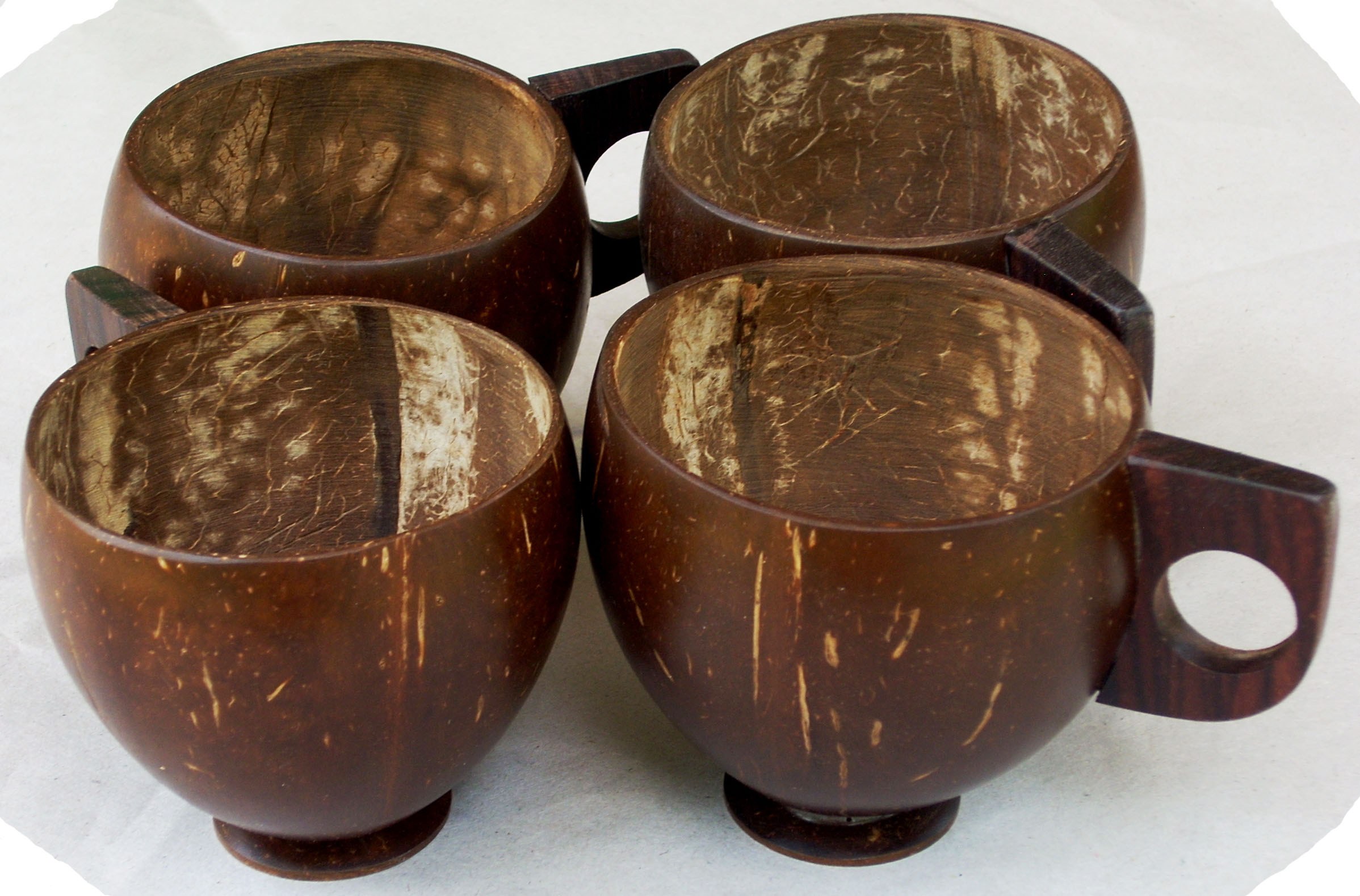
  8. In case of a bigger object such as an ice cream cup or a bowl, the whole shell is used by cutting it as per the required size. Various designs are engraved in the shell using a file.
  9. After the object is made it is sanded with sand paper till it is smooth. It is then polished with bees wax. Alternatively, if a glossy finish is desired, it is given a coat of synthetic varnish. If the surface is to have a dark finish then it is painted before the varnish coat is applied. The inside of the object in this case is first rubbed with sand paper to get the desired smoothness and then it is buffed on the machine. No varnish or bees wax is applied on the inside if the object is to hold foodstuff.
  10. The piece is dried in the sun.

Coconut Wood Craft
The craft production process for the wood craft is as follows:
  1. The design is sketched on paper with measurement details.
  2. Wood is placed in the turning machine. In case of small products such as pen
    holders/candle holders, three to four products are carved out from a piece of timber
    and the whole piece is put on the turning machine. After the outside surface designs
    have been carved for all the pieces, the combined piece is removed. Individual pieces
    are then cut and put again on the turning machine to scoop out and create the
    hollow inside.
  3. The artisan marks the design areas by measuring with a scale and holding a pencil at
    that point against the rotating wood. He then holds an assortment of chisels, sand
    paper and files against the rotating timber to carve out the designs and to create the
    shapes for a particular product.
  4. At each stage sanding is done to make the surface smooth. Finally buffing is done for
    the inside surface in case of a hollow product or serving bowl. Small pores, which are
    characteristic of any wood, are filled with a paste of Fevicol and saw dust and then
    filed/sanded.
  5. For hollow products such as pen holders / candle holders / bowls, the individual
    pieces are cut from the main block of wood and the wood from the inside is scooped
    out.
  6. If a photo frame is to be made then the wood is first sanded and filed and the
    members of the photo frame are cut in a photo frame cutting machine. This cuts the
    wood with an angle to make the frame. The inclined cut is joined with the other
    member using Fevicol.
  7. The inside portion is buffed on the machine and if the product is to hold food no
    other finishing coat is applied.
  8. A coat of varnish is applied and dried to give a shine to the product. For any product

    in which foodstuff is to be kept only bees wax is applied.


Handicraft Coconut shell Kudam

How to make a coconut jewel-box

How to make a Coconut Palm Leaf Hat

QWhat sorts of handicraft items can you make with a coconut shell?

ACoconut shells are used to make a variety of handmade items, including candle holders, jewelry and accessories, kitchen and household items, figurines and many other products. Rugs, mats and wall hangings are also made from the fiber around the nut.

A coconut-shell candle holder is a simple product that is made with coconut halves. With a wick mounted in the center, melted wax is poured into the sliced shell. Complementing home decor with a natural style, this piece makes a nice gift.

A jewelry box made from a coconut shell is another craft project that is great as a gift. Coconut shells are also used to make necklaces, pendants, bracelets, earrings, belts and other accessories.

Dining sets and dishes made with coconut shells are common in various tropical locations. Coconut shells, cut into half or pieces, are used to make kitchen items such as cups, bowls, ladles and spoons. They are also used to make plates and coasters. Other household items made with coconut shells include vases, hanging planters and bird houses.


Making coconut-shell sculptures and figurines is an artistic craft that many people enjoy. Intricately carved figurines made with coconut shells are designed with themes such as animals, sea creatures and flowers.
What sorts of handicraft items can you make with a coconut shell?
COCONUT SHELL HANDICRAFT

The unconventional creativity employed in coconut shell crafts is close to nature.
The raw coconut shells make them completely friendly and the seasoned craftsmanship brings out a captivating beauty.
The skills of the creator are beautifully presented by their elegance and simplicity.
This makes coconut shell crafts a perfect gift for our loved ones.
The strength and durability of usage helps them find their way into homes, offices, restaurants and hotels.

In Bali are crafted from coconut shell, coconut wood, coconut fibre and other natural materials.
The product line ranges from utility products like bowls, cups, buttons & beads,goblets, spoon/forks, etc.

To fashion belts, coconut bras, buckles (sarong holders), bird houses/feeders, jewellery, coconut and bamboo candles and candle holders, etc.
Coconut Shell Handicraft
source
Coconut Shell Handicraft
source
Coconut Shell Handicraft
source
Coconut Shell Handicraft
source
Coconut Shell Handicraft
source
Coconut Shell Handicraft
source
                                              
How to Start a Coconut Handicrafts and Novelty Items Making Business


Researchers at the Philippine Coconut Authority – Zamboanga Research Center (PCA-ZRC) introduced the “one-nut concept” as a method of producing wares and novelty items from a single piece of coconut fruit. Following this concept, the residues from matured coconut fruits were crafted into a new high value-added products by employing the “mix and match” technique.

source
Coconut varieties such as the PCA SYN VAR or GMA Farmers variety and “kiamba” green dwarf are made into coco clocks, trays, and other similar products. Fronds are likewise turned into crafts.

Skillfulness, creativity and craftsmanship on the part of the people involved in the job are necessary to come up with new and exciting products. Some of the crafts and novelty items produced are all-purpose trays, trophies, flower vases and candle holders, chairs, dividers, plant boxes, tables, and dressers. The production costs for such crafts is about 50-60% cheaper than the traditional materials such as wood.

Production Method

A. Coconut Fronds

1. Collecting and drying of fronds 
Collect fronds during nut harvesting. If they are left on the field, they are attacked by wood-boring insects and fungi that abound on coconut. These pests inflict serious damage to all parts of the fronds, thus, reducing their strength and visual value.

2. Drying
After gathering, clear fronds of leaflets and dry naturally under shed. Drying times ranges from 4 weeks to 6 weeks depending on weather conditions.

3. Machining, ripping/sawing 
Cut fronds with either manual or motor driven saws. Polish, machine and assemble using common wood working tools. For added strength, combine the fronds with light woody materials or thin plywood (e.g., 1/8) when used in furniture, novelty items and other fixtures.

4. Preserving treatment 
Prior to assembly, treat dried raw materials with preservatives such as “Cuprinol” or “Solignum”. This is necessary to prevent infestation by wood boring insects. A mixture of Cuprinol and kerosene can be used at 8:1 ratio (kerosene: preservative).

5. Assembly 
Nails and common white glues, e.g, Elmer’s are effective fasteners. Split rattan can also be used as a mechanical binder. It does not only add strength, but also improves the aesthetic appeal of the product.

6. Finishing
Sand the wood smooth before finishing. Then apply two to three coats of lacquer sanding sealer before the final coating of varnish or clear gloss lacquer.

7. Packaging 
Corrugated paperboards, molded and fashioned into rigid boxes, are good packaging materials for products such as picture frames, and other novelty items.

B. Coconut Fruit Residues

Some of the handicraft items that can be produced from coconut fruit residues are trays, plant pots, coco clocks, coco trophies, and coin banks. The process involves the following steps:

1. The coconut variety “Kiamba” green dwarf is suitable for making coco clock and trophies because of its size and shape. Likewise, the dwarf variety “Mangipod” is a good material for making all-purpose trays.

2. Slice/ cut the materials using a sharp narrow band saw (2 wide). Use a motor-driven sander for sanding. Use glues such as PVA or urea formaldehyde and wooden dowels as fasteners to assemble the product. Nails of any metal fasteners could not easily hold the husk due to its naturally loose structure.

3. For coco clock, saw parallel through the polar section of the nut. For the trays, it is ideal to cut across the equatorial section.

4. When finishing, machine-sand with coarse abrasives to level off the surface and make it even. Further, sand manually using a fine abrasive for a smooth surface prior to application of a topcoat of varnish.


5. Since the husk takes in a great quantity of finishing materials, seal with PVA emulsion glue before applying topcoat. Among the suitable top coating materials are clear gloss lacquer, polyurethane and varnish. Brush on three to four coatings of the finishing material. It is best to topcoat during hot and dry weather.